

Buyer Quote Intelligence is now live: market intelligence embedded into RFQ creation
Reduce RFQ uncertainty, improve quote participation, and surface data-backed context before an RFQ is posted.
When buyers post RFQs with unclear or incomplete requirements, suppliers are forced to guess. That uncertainty often shows up as slower quoting, fewer responses, more clarification cycles, and wider variation in price and lead time.
Today we’re announcing the launch of Buyer Quote Intelligence — a new intelligence layer built directly into the RFQ creation flow to help buyers create clearer, more quotable RFQs before they hit “Post.”
What is Buyer Quote Intelligence?
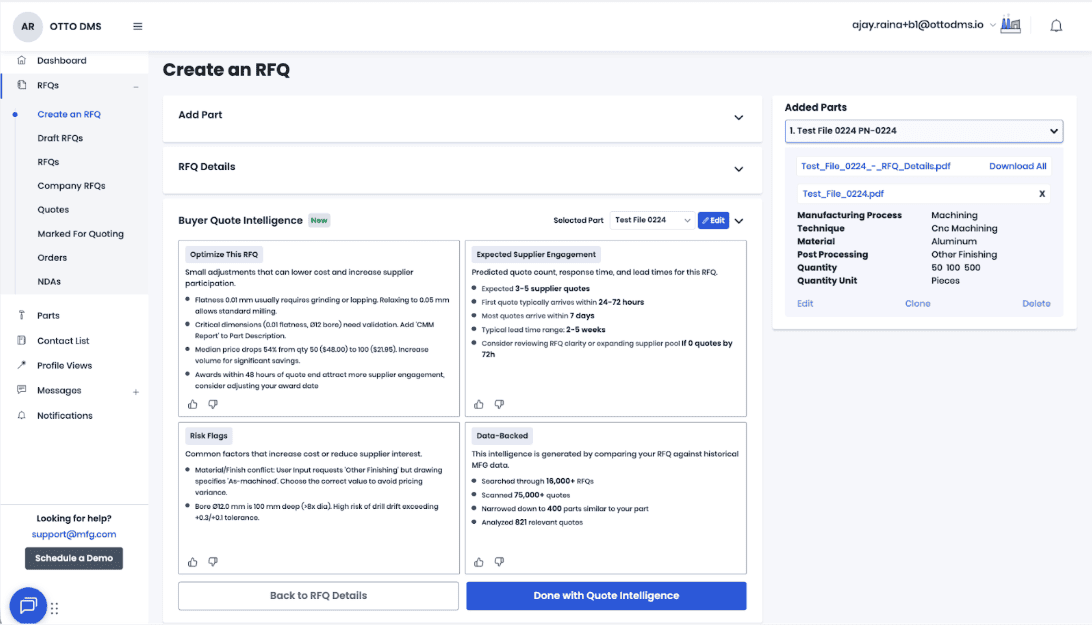
Buyer Quote Intelligence provides real-time guidance inside RFQ creation. As the buyer completes RFQ details and uploads part files, the system evaluates the RFQ and generates structured insights that help reduce ambiguity and improve quoting outcomes.
This is not a separate tool or report — it’s embedded into the workflow where buyers already create RFQs.
Create RFQ – Buyer Quote Intelligence
What’s included in V1
Buyer Quote Intelligence is delivered through four cards inside the RFQ flow:
1) RFQ Optimizations
Actionable suggestions to help buyers clarify key requirements and reduce avoidable uncertainty. The goal is to improve quoting accuracy and increase supplier participation by tightening the details suppliers need to quote.
Examples of what this might include:
- missing requirements that commonly drive supplier questions
- areas where clarifying a detail can reduce quoting friction
- opportunities to structure requirements for faster supplier evaluation
2) Supplier Risk Checks
Suppliers price risk. When requirements are ambiguous or conflicting, suppliers often protect themselves with lead-time buffers, higher pricing, or quote exceptions.
Risk Checks surface common quoting risk points so buyers can address them upfront — before suppliers need to request clarification.
3) Expected Supplier Engagement
RFQ creation shouldn’t feel like a black box. Expected Supplier Engagement provides a forecast of:
- expected quote participation (how many quotes are likely)
- typical timing (when quotes tend to arrive)
- early signal if an RFQ is trending toward low response
If expected engagement is low, buyers can adjust the RFQ before posting to improve participation.
4) Data-Backed Context
To build trust and transparency, the Data-Backed card shows the scale behind the insights — including how many RFQs and quotes were referenced and how many similar parts were matched.
This helps buyers understand that the recommendations are grounded in historical quoting behavior — not generic advice.
Why we built this
RFQs are the starting point of the sourcing process. When RFQs are unclear, everyone pays the tax:
- buyers wait longer and receive inconsistent quotes
- suppliers spend time clarifying rather than quoting
- both sides burn cycles before a quote is even actionable
Buyer Quote Intelligence is designed to reduce that tax by improving RFQ clarity at the point of creation.
How to access it
Buyer Quote Intelligence is now live in the RFQ creation flow. To try it:
- Create a new RFQ
- Upload part files and complete the RFQ details
- Review the Quote Intelligence cards and apply any recommended updates
- Post the RFQ when ready
What’s next
This release is the first step in expanding intelligence throughout the sourcing workflow. We’ll continue iterating on:
- deeper RFQ validation and requirement coverage
- more granular engagement forecasting
- expanded transparency into what drives quoting behavior and outcomes